Last updated on August 13th, 2026
Most companies do not decide to outsource graphic design because of a single event. It happens gradually. A founder starts building slide decks at midnight, a marketing manager adds design to a job description that already has six other functions, and campaigns slip a week because nobody has time to finish the creative. By the time leadership actually discusses outsourcing, design has usually been quietly slowing the business down for months.
Outsourcing is not automatically the right move, though. Some businesses genuinely need a full-time hire, and others do fine with the occasional freelancer. This guide walks through the signs that indicate outsourcing has become the more sensible option, what it costs, and how to prepare before making the switch.
Table of Contents
When Should You Outsource Graphic Design?
10 Signs Your Business Is Ready to Outsource Graphic Design
When Should You Outsource Graphic Design?
Outsource graphic design when the demand for design work is consistent enough to matter but not large enough to justify a dedicated full-time hire, or when the work requires specialized skills your current team doesn’t have.
There is no universal headcount or revenue threshold that triggers this decision. A ten-person startup running constant paid social campaigns may need outsourced design support sooner than a fifty-person company with a slower, more predictable content calendar. What matters is the combination of workload, complexity, and how closely the design work needs to be coordinated with other teams.
Businesses with occasional, simple design needs can usually get by with in-house staff handling design as a secondary responsibility. Businesses with steady, moderately complex needs, but not enough volume to fill a full-time role, tend to benefit most from outsourcing. Businesses with heavy, ongoing design demand across many formats often end up needing both an in-house lead for strategy and brand consistency, plus outsourced production capacity to handle volume.
Deploy a virtual assistant to expand your internal bandwidth without full-time hiring costs
Get flexible design support that scales with your business.
10 Signs Your Business Is Ready to Outsource Graphic Design
The signs below rarely show up in isolation. Most businesses recognize two or three of these patterns happening at once, which is usually a stronger signal than any single item on its own.
1. Non-design employees are creating visuals
What it looks like: Marketing managers, founders, sales reps, and operations staff are building graphics in Canva or PowerPoint instead of doing their actual jobs.
Why it matters: Every hour a marketing manager spends formatting a slide is an hour not spent on strategy, campaigns, or analysis. The opportunity cost compounds quickly across a team.
2. Your design queue keeps growing
What it looks like: Requests pile up faster than they get completed. Multiple campaigns compete for the same limited hours, and prioritization becomes a recurring argument.
Why it matters: A backlog is a capacity signal, not a scheduling problem. Reshuffling priorities does not fix a queue that is structurally too large for the available hours.
3. Design is causing missed marketing deadlines
What it looks like: Ad creative, product launch assets, email campaigns, social content, or sales decks go out late or get simplified because there wasn’t time to do them properly.
Why it matters: Deadlines tied to launches, promotions, or sales cycles are usually fixed. When design can’t keep pace, the business absorbs the cost through delayed revenue or rushed quality.
4. Your brand looks inconsistent across channels
What it looks like: Fonts, colors, layouts, and imagery vary between the website, social channels, and printed materials. Templates either don’t exist or aren’t followed.
Why it matters: Inconsistent branding undermines the credibility a business is trying to build with every other marketing dollar it spends. It also makes every new asset slower to produce, since there’s no standard to work from.
5. You need skills you don’t have internally
What it looks like: Motion graphics, packaging, illustration, infographics, UI/UX, print production, or presentation design fall outside your current team’s expertise.
Why it matters: Hiring a full-time specialist for a skill you need occasionally rarely makes financial sense. Outsourcing gives access to that expertise only when it’s actually needed.
6. Design demand swings month to month
What it looks like: Some months are quiet, while others are packed with launches, campaigns, or seasonal pushes.
Why it matters: Fixed in-house staffing is built for average demand, which means it’s either underused in slow months or overwhelmed in busy ones. Variable demand is easier to match with flexible capacity.
7. Design costs keep surprising you
What it looks like: Freelancer invoices, overtime, software subscriptions, and recruiting costs add up in ways that are hard to predict from month to month.
Why it matters: Unpredictable costs make budgeting difficult. A structured outsourcing design service, whether hourly, project-based, or retainer, tends to be easier to forecast than a patchwork of ad hoc freelance hires.
8. You need more output without another full-time hire
What it looks like: The volume of design work has grown, but adding headcount feels premature or hard to justify given current budget constraints.
Why it matters: Outsourcing offers a way to scale production capacity without the fixed cost, benefits, and management overhead that come with a new employee.
9. Your team is producing “good enough” designs
What it looks like: Work gets done, but it’s technically acceptable rather than genuinely well branded or built with conversion in mind.
Why it matters: There’s a real difference between something that looks fine and something that’s designed to perform. If design is meant to support sales or marketing outcomes, “good enough” often isn’t.
10. Design has become a recurring operational function
What it looks like: Design requests are no longer occasional projects. They happen every week, across multiple teams, as a normal part of running the business.
Why it matters: Once design behaves like an ongoing operational function rather than a one-off task, it usually needs to be resourced like one, whether that’s through outsourcing, a hire, or a mix of both.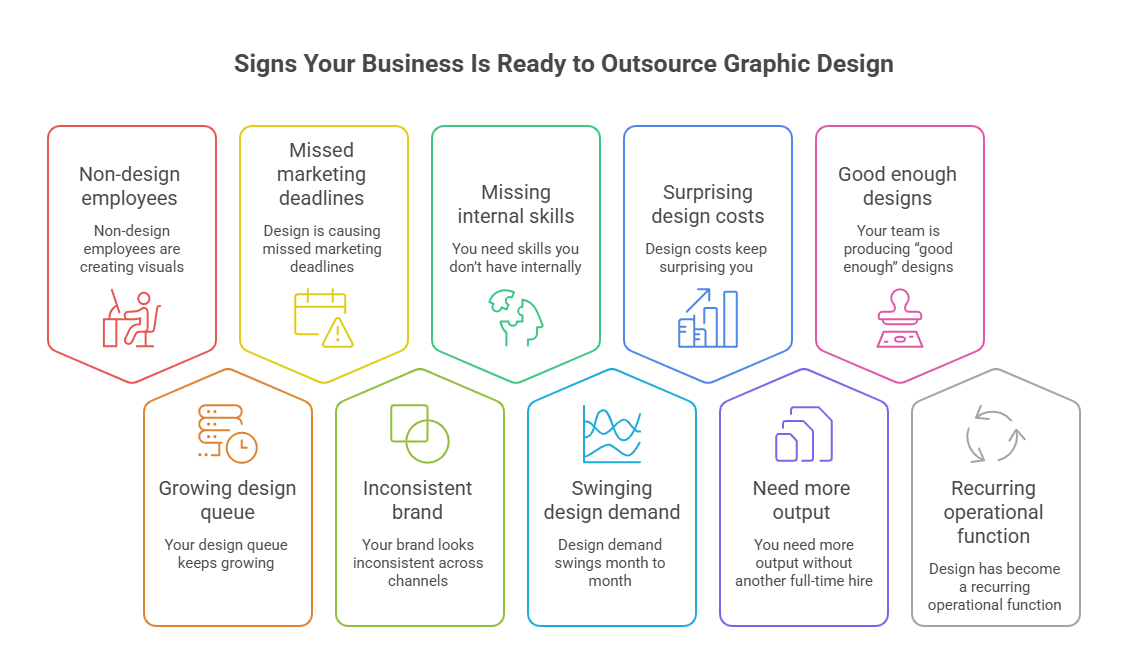
How to Prepare Your Business for Outsourced Graphic Design
Outsourcing works best when a business has done some groundwork before handing off the first project. Start by documenting whatever brand standards already exist, including logo usage, color palettes, fonts, and any templates currently in use. If none of this is formally written down, even a basic style reference will save significant back-and-forth later.
Next, take stock of the type and volume of design work you actually need. A business that mainly needs social graphics and email templates has very different requirements than one that needs packaging design, motion graphics, and UI work. This distinction matters because it affects whether a freelancer, a specialized agency, or a broader outsourced team is the better fit.
It also helps to define how design requests will be submitted, reviewed, and approved. Businesses that skip this step often end up with the same bottlenecks they were trying to outsource away from, just shifted onto an external partner instead of an internal employee. A simple intake process, clear turnaround expectations, and a single point of contact for feedback go a long way toward making the relationship work.
Finally, set a few measurable goals for the engagement before it starts. That might be turnaround time, output volume, consistency across channels, or cost per asset compared to current spend. Having these benchmarks in place makes it much easier to evaluate whether outsourcing is actually delivering the results the business expected.
FAQ
1. Is it cheaper to outsource graphic design than hire in-house?
It often is, particularly when design needs don’t justify a full salary, benefits, software licenses, and management time. The comparison depends heavily on volume and complexity, so it’s worth calculating your actual in-house cost per asset before assuming outsourcing is cheaper.
2. What size business should outsource graphic design?
There’s no fixed size threshold. Small businesses with limited design needs and large enterprises with specialized, high-volume demands both outsource for different reasons. The decision depends more on workload and skill requirements than headcount.
3. How do I know if I need a freelancer or a design agency?
Freelancers tend to work well for narrower, project-based needs with a single point of contact. Agencies or outsourced teams tend to work better when you need broader capacity, multiple skill sets, or ongoing production support across several channels.
4. What graphic design tasks are easiest to outsource?
Repeatable, well-defined tasks such as social media graphics, email templates, presentation design, and basic marketing collateral tend to be the easiest to hand off, since they require less ongoing strategic input.
5. Should startups outsource graphic design?
Many startups outsource design early on because it avoids the cost of a full-time hire while the business is still figuring out its brand direction and content volume. As needs grow more consistent, some eventually bring design in-house.
6. Can small businesses outsource graphic design?
Yes. Outsourcing is often more accessible for small businesses than hiring, since it doesn’t require the fixed overhead of a full-time employee and can scale up or down with demand.
7. Is it better to outsource graphic design or hire a designer?
It depends on consistency and volume. Steady, high-volume, strategically important design work often justifies an in-house hire, while variable or specialized work tends to suit outsourcing better.
8. What are the disadvantages of outsourcing graphic design?
Common challenges include less immediate availability, potential communication delays, less built-in familiarity with brand nuance, and the need for a clear review process to maintain quality and consistency.
9. How much does outsourced graphic design cost?
Costs vary widely based on scope, complexity, and pricing model, whether hourly, per project, or retainer-based. Businesses should compare quotes against their actual in-house cost per asset rather than relying on a single benchmark figure.
10. How do I protect my brand and intellectual property when outsourcing?
Use a clear agreement covering ownership of final files, confidentiality, and usage rights before work begins. Sharing a documented brand style guide also reduces the risk of inconsistent or off-brand output.
Final Verdict: When Should You Outsource Graphic Design?
Outsourcing makes sense when design has turned into a bottleneck rather than staying a strategic advantage. The right model depends on your workload, the complexity of the work, how much collaboration it requires, and what your budget can support.
For most businesses, that means keeping core brand strategy and high-level creative direction in-house while using outsourced design partners for scalable production and specialized skills the internal team doesn’t have. Rather than committing to a long-term arrangement immediately, it’s worth starting with a defined pilot project and a small set of measurable goals. That approach makes it much easier to see whether outsourcing actually solves the problem before scaling the relationship further.

recruitninjas
Cynthia David is a Principal Product Marketing Manager for Adobe Document Cloud, focusing on Acrobat, Acrobat Sign, and Acrobat Services. She has background in messaging, marketing campaigns, communications, social media, events, content marketing, and partnerships. She is passionate about understanding customer needs and connecting with customers.