Last updated on August 4th, 2026
Building a high-growth company requires immediate access to skilled professionals without burning through limited venture capital. Leveraging remote staffing for startups provides founders with a proven framework to build distributed teams quickly and cost-effectively.
This guide is designed for founders, talent managers, and executive leaders who want to scale operational capacity. You will learn how to identify key roles, evaluate hiring partners, maintain legal compliance, and manage remote team performance.
Table of Contents
Why Startups Choose Remote Staffing
When Is the Right Time to Build a Remote Team?
Which Startup Roles Should You Hire Remotely First?
How to Build a Remote Hiring Process
Choosing the Right Remote Staffing Partner
Remote Onboarding Best Practices
Legal, Payroll, and Compliance Considerations
Why Startups Choose Remote Staffing
Adopting a distributed team model allows early-stage companies to bypass geographical hiring restrictions and reduce overhead costs. Working with remote staffing agencies enables founders to focus on product development while talent experts handle candidate acquisition.
- Access to global talent: Tap into specialized international talent pools without being restricted by local labor market shortages.
- Faster hiring: Accelerate recruitment timelines by accessing pre-vetted talent pipelines ready for immediate deployment.
- Reduced operational costs: Save on office leases, physical equipment, local benefits packages, and utility bills.
- Greater flexibility and scalability: Scale your workforce up or down rapidly in response to market demands and funding rounds.
- Around-the-clock productivity: Maintain continuous operational workflows by leveraging team members across different time zones.
When Is the Right Time to Build a Remote Team?
Determining the optimal time to build a distributed workforce depends heavily on your funding stage and core business objectives. Choosing to outsource non-core operational tasks early preserves internal resources for fundamental product development.
- Pre-seed: Hire contract developers or specialized advisors to build initial prototypes without full-time payroll commitments.
- Seed: Bring on dedicated support specialists and software engineers to accelerate market testing and customer validation.
- Series A: Expand core engineering, marketing, and sales development teams to support rapid customer acquisition.
- Growth stage: Scale operational infrastructure, customer success teams, and back-office finance roles across global regions.
- Expansion phase: Establish localized regional teams to penetrate international markets and provide localized customer care.
Partner with a dedicated remote staffing agency to recruit, onboard, and manage top global professionals.
Which Startup Roles Should You Hire Remotely First?
Certain organizational roles transition seamlessly to distributed work environments due to digital workflows and clear deliverables. Utilizing remote staffing for startups allows leadership teams to fill these critical vacancies with highly experienced talent.
- Software engineering: Full-stack, backend, frontend, and DevOps engineers who collaborate using cloud code repositories.
- Product design: UI/UX designers who create visual prototypes, wireframes, and design systems using cloud tools.
- Customer support: Help desk agents who manage support tickets, live chat queries, and customer onboarding across time zones.
- Sales development: Outbound sales reps who qualify leads, set up sales meetings, and manage CRM databases.
- Marketing: Content writers, SEO specialists, performance marketers, and social media managers who drive digital awareness.
- Finance: Bookkeepers, accountants, and financial analysts who handle payroll processing, invoicing, and reporting.
- Operations: Logistics coordinators, data entry specialists, and workflow managers who keep projects on schedule.
- Virtual assistants: Administrative staff who manage founder calendars, schedule travel, and clear daily inboxes.
How to Build a Remote Hiring Process
Establishing a standardized hiring pipeline ensures consistent candidate quality and reduces long-term attrition rates. Partnering with top remote staffing agencies helps streamline each phase from initial sourcing to final job offer.
- Define hiring needs: Create detailed role profiles, clear performance expectations, and specific technical skill requirements.
- Source candidates: Reach out through global job boards, talent marketplaces, and specialized recruitment networks.
- Screen applicants: Filter resumes based on technical experience, communication skills, and remote work readiness.
- Conduct structured interviews: Use standardized question rubrics to evaluate cultural fit, problem-solving abilities, and domain knowledge.
- Skills assessments: Assign practical design or coding challenges to verify candidate competence under realistic work conditions.
- Reference checks: Speak with past managers to confirm technical capability, work ethic, and professional reliability.
- Offer and onboarding: Extend competitive compensation packages and guide new hires through structured documentation setup.
Choosing the Right Remote Staffing Partner
Selecting an experienced staffing agency significantly reduces the time and effort required to recruit global talent. When you decide to outsource key hiring tasks, you must evaluate prospective partners on their industry background and vetting procedures.
- Evaluation criteria: Look for proven experience within your specific industry, high candidate retention rates, and clear service terms.
- Pricing models: Assess flat-rate placement fees, monthly management retainers, or markup percentages on worker pay rates.
- Vetting standards: Ensure the vendor conducts rigorous technical testing, language proficiency evaluations, and background checks.
- Geographic expertise: Select partners with deep knowledge of talent markets, salary benchmarks, and labor laws in target countries.
- Communication practices: Demand transparent reporting, dedicated account managers, and regular performance review check-ins.
- Red flags to avoid: Steer clear of vendors with vague pricing, hidden administrative fees, unverified candidate pools, or high turnover rates.
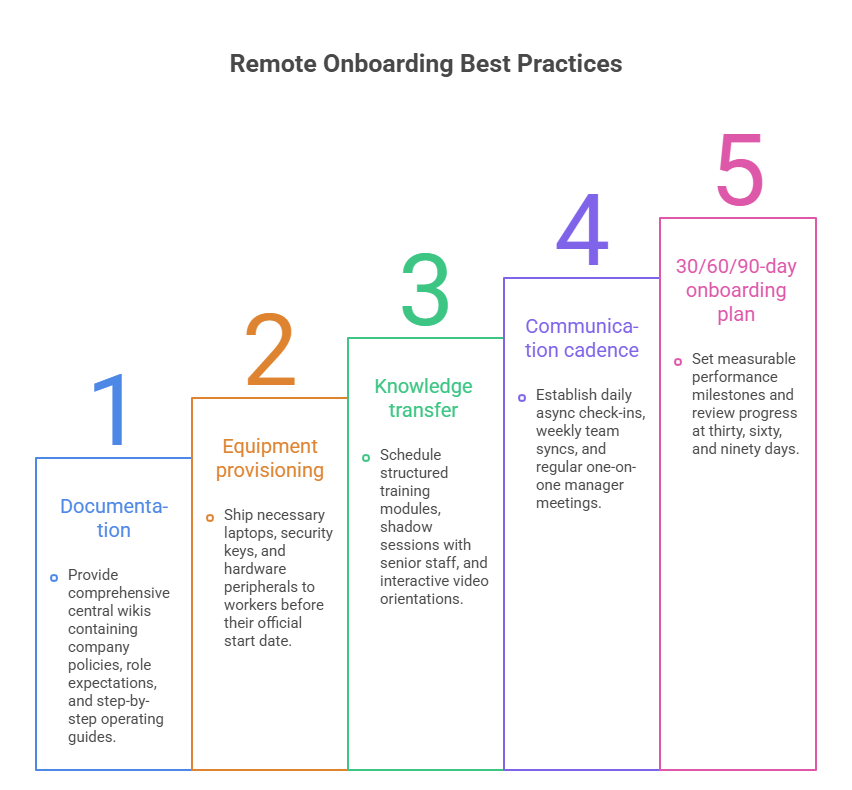
Remote Onboarding Best Practices
A structured onboarding program sets clear expectations and accelerates the time it takes for new hires to become productive team members. Proper onboarding builds strong engagement and lowers early employee churn rates across distributed teams.
- Documentation: Provide comprehensive central wikis containing company policies, role expectations, and step-by-step operating guides.
- Equipment provisioning: Ship necessary laptops, security keys, and hardware peripherals to workers before their official start date.
- Knowledge transfer: Schedule structured training modules, shadow sessions with senior staff, and interactive video orientations.
- Communication cadence: Establish daily async check-ins, weekly team syncs, and regular one-on-one manager meetings.
- 30/60/90-day onboarding plan: Set measurable performance milestones and review progress at thirty, sixty, and ninety days.
Legal, Payroll, and Compliance Considerations
Managing global talent requires strict adherence to local labor laws, tax regulations, and data security standards. Choosing to outsource human resources management to specialized platforms helps founders navigate international legal complexities smoothly.
- Contractor vs employee: Properly classify global workers to prevent severe tax penalties and legal misclassification liabilities.
- Employer of Record (EOR): Partner with an EOR entity to hire full-time international workers legally without establishing local corporate entities.
- Payroll: Automate multi-currency payroll distribution to ensure on-time salary payments across international banking networks.
- Tax obligations: Withhold local taxes correctly and submit required international compliance documentation to tax authorities.
- Data security: Implement strict endpoint security protocols, VPN requirements, and multi-factor authentication across all devices.
- Intellectual property protection: Require international workers to sign comprehensive IP assignment agreements to protect proprietary assets.
Common Remote Staffing Mistakes
Avoiding common recruitment blunders saves startups valuable capital and prevents team disruption. Using established remote staffing agencies helps founders avoid these operational traps and build resilient organizations.
- Hiring too quickly: Rushing candidate evaluations often leads to hiring individuals who lack necessary technical skills or self-management abilities.
- Poor role definitions: Failing to define clear deliverables creates worker confusion, overlapping duties, and missed deadlines.
- Weak onboarding: Neglecting structured training leaves new hires isolated and unprepared to handle daily operational tasks.
- Ignoring culture fit: Focusing solely on technical skills while overlooking communication style can harm team morale and cohesion.
- Misclassification risks: Treating full-time international workers as independent contractors can trigger severe legal fines and back taxes.
- Lack of documentation: Relying on informal verbal instructions instead of written documentation leads to operational inconsistency.
Remote Staffing Costs and ROI
Evaluating the financial impact of a distributed team involves analyzing initial recruitment costs against long-term operational efficiency gains. Implementing remote staffing for startups typically results in substantial cost reductions compared to local hiring markets. Many growing organizations choose to outsource recruitment functions to minimize internal HR workload and lower expenses.
- Cost components: Include base salaries, agency placement fees, localized benefit packages, software licensing, and hardware shipping.
- Salary benchmarks by region: Save up to 60 percent on base compensation by hiring talent in Latin America, Eastern Europe, or Asia.
- Agency fees: Account for vendor markups, monthly management retainers, or one-time placement costs when budgeting.
- Hidden expenses: Factor in potential currency conversion fees, international banking wire charges, and legal consultation costs.
- Measuring return on investment: Calculate ROI by comparing customer acquisition speed, project delivery velocity, and total cost savings.
Conclusion
Building a distributed team offers early-stage companies an unprecedented opportunity to access top-tier talent while preserving critical capital. By implementing structured hiring processes and clear onboarding plans, founders can scale their operations efficiently across global markets.
Working with specialized partners and leveraging remote staffing for startups simplifies legal compliance, payroll, and candidate sourcing. Taking a strategic approach to global recruitment ensures your organization remains agile, competitive, and positioned for long-term success.
Are you ready to accelerate your growth trajectory and build an exceptional distributed team? Partner with leading global recruitment experts today to access pre-vetted talent and scale your business with total confidence.
Frequently Asked Questions
1. What is remote staffing?
Remote staffing is an operational hiring model where businesses employ skilled professionals who work from non-office locations worldwide. Companies often work with specialized agencies to source, vet, and manage distributed team members.
2. Is remote staffing suitable for early-stage startups?
Yes, remote staffing is ideal for early-stage startups because it significantly lowers operational overhead and accelerates hiring speed. It allows founders to stretch seed funding further while accessing specialized talent immediately.
3. How much does remote staffing cost?
The total cost varies based on candidate location, technical role complexity, and agency service fees. Generally, hiring international remote talent reduces base salary expenses by 40 to 70 percent compared to domestic US hiring.
4. Should I use a staffing agency or hire directly?
Using a staffing agency saves time, mitigates international compliance risks, and provides pre-vetted candidates quickly. Direct hiring offers slightly more direct control but requires significant internal HR, legal, and recruitment bandwidth.
5. What roles are easiest to hire remotely?
Digital roles such as software engineering, UI/UX design, customer support, content marketing, and sales development are easiest to fill remotely. These positions rely primarily on cloud tools and async communication workflows.
6. How do I onboard remote employees effectively?
Onboard remote employees effectively by providing clear written documentation, shipping equipment early, and setting up structured training modules. Assigning a team mentor and defining clear 30/60/90-day goals also accelerates integration.
7. How do I ensure legal compliance when hiring internationally?
Ensure international compliance by partnering with an Employer of Record (EOR) or using specialized global payroll platforms. These providers manage local labor contracts, tax withholdings, and statutory benefits correctly.
8. What tools help manage remote teams?
Essential management tools include communication platforms like Slack, project management software like Jira, and documentation hubs like Notion. Time tracking and async video tools like Loom also keep distributed teams aligned.
9. How long does remote hiring typically take?
Remote hiring through a specialized agency typically takes two to three weeks from initial role intake to candidate offer acceptance. Direct international recruiting without agency support can take six to ten weeks.
10. How can I improve retention in a distributed workforce?
Improve retention by offering competitive global salaries, promoting transparent communication, providing career growth paths, and respecting time zone boundaries. Regular virtual team-building events and performance recognition also boost loyalty.

recruitninjas
Cynthia David is a Principal Product Marketing Manager for Adobe Document Cloud, focusing on Acrobat, Acrobat Sign, and Acrobat Services. She has background in messaging, marketing campaigns, communications, social media, events, content marketing, and partnerships. She is passionate about understanding customer needs and connecting with customers.