
Last updated on January 6th, 2026

Fast-growth companies need to have just the right number of employees. One day, the team feels perfect, and work gets done on time. The next day, it feels quite small. Hiring becomes urgent, and finding the right candidate then becomes overwhelming and messy. Resumes pile up, and interviews stretch, and good candidates slip away quietly.
Growth does not wait for perfect hiring systems. This is where many fast-scaling businesses pause and rethink how they hire. They do not add any more internal pressure. They just change the way recruitment itself works. This shift has made recruitment process outsourcing more than a trend. It has made it a survival strategy.
Instead of handling everything in-house, companies now lean on structured partners. They use smarter tools and refined hiring flows. The result is speed with control. It is hiring that supports growth rather than slowing it down. Companies that use recruitment process outsourcing often achieve around 40% faster hiring times compared to traditional internal recruiting processes, significantly reducing time-to-hire metrics.
Table of Contents
Why Fast-Growth Companies Struggle With Hiring
What Recruitment Process Outsourcing Really Means
Top 8 Recruitment Process Outsourcing Benefits
RPO vs Staffing Agency: Understanding the Difference
The Role of E-Recruitment Process in RPO

Why Fast-Growth Companies Struggle With Hiring
When growth accelerates, you start to feel the need to hire. Internal teams are already juggling too much. Managers are interviewing between meetings. HR teams become gatekeepers, schedulers, and negotiators all at once. Decisions get quite delayed, while candidates lose interest. Costs rise needlessly.
Many companies try to fix this by hiring recruiters internally. Others turn to agencies for some quick fills. Both solutions help for a while, but neither quite fixes the system.
This is why recruitment process outsourcing has gained attention. It works especially among companies scaling teams across roles, locations, and timelines.
What Recruitment Process Outsourcing Really Means
Recruitment process outsourcing is not much about giving away hiring control. It is more about redesigning how hiring works.
In RPO, a specialized partner manages part or all of the recruitment cycle. They take care of everything, from sourcing and screening to interviews and onboarding support. The process aligns with the company’s goals, culture, and growth pace.
It sits quite differently from business process outsourcing, where entire back-office functions are handed over. RPO is focused, intentional, and built around talent.
Top 8 Recruitment Process Outsourcing Benefits
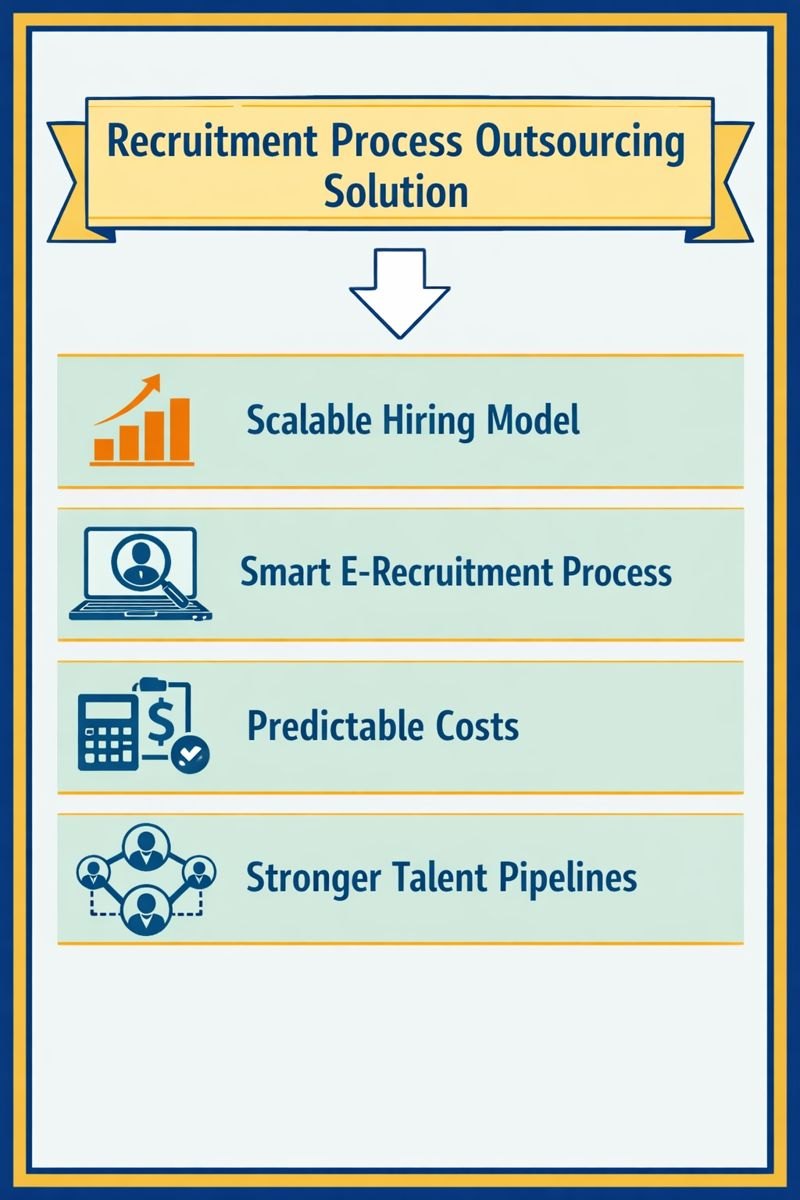
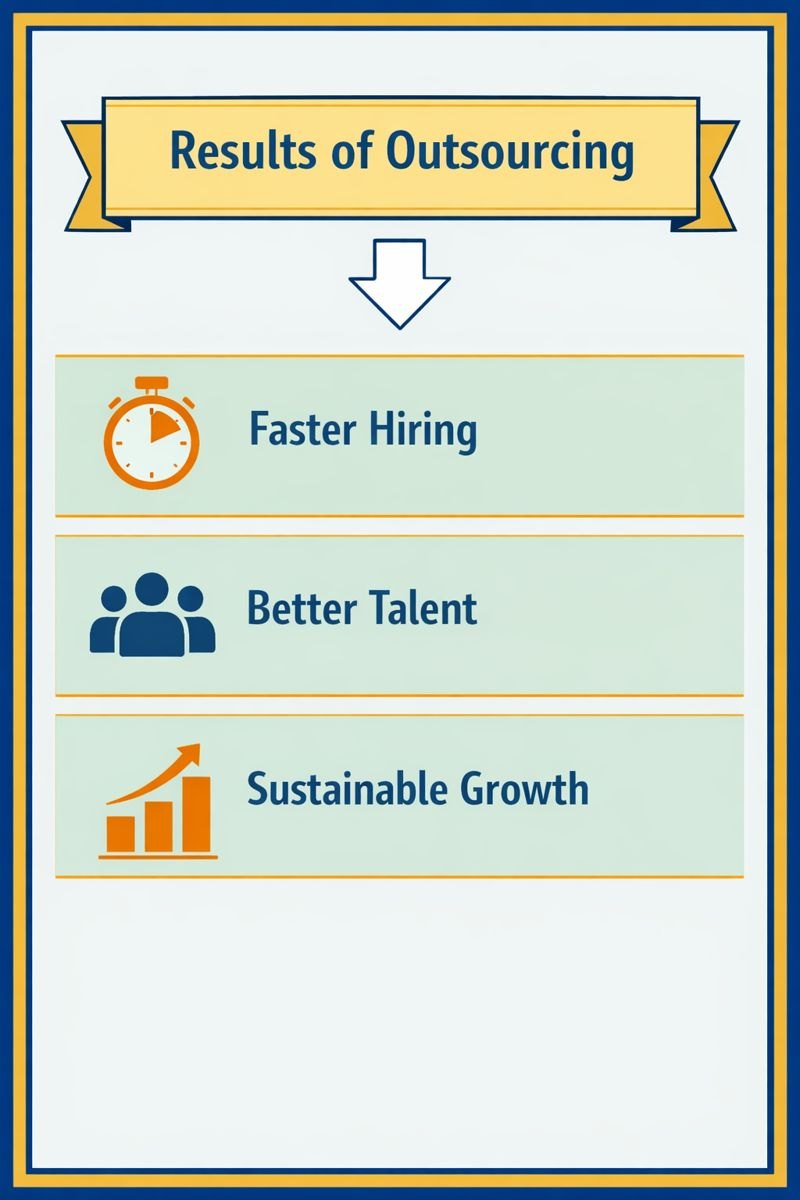
1. Faster Hiring Without Panic
Speed matters when growth is real. RPO teams are built to hire at scale. They use tested workflows, ready talent pools, and quite efficient screening systems. Roles move faster from requirement to offer.
This removes last-minute rush hiring and reduces vacant-role pressure.
2. Predictable Hiring Costs
Unplanned hiring is expensive. Recruitment process outsourcing offers quite clearer cost structures compared to constant agency fees or repeated internal hiring cycles. Costs become predictable. As a result, budgets stabilize.
For fast-growth companies, this clarity supports much better financial planning.
3. Access to Better Talent Pipelines
RPO providers build long-term talent pipelines. Candidates here are not just quick matches.
They are passive candidates who are tracked and nurtured through relationships. They maintain databases aligned to future roles. This gives companies access to talent much before the hiring alarm rings.
This is something most internal teams struggle to maintain.
4. Scalable Hiring Models
Growth is uneven. Some months require five hires, and others may need fifty. RPO models scale up or down easily without the company hiring or firing recruiters internally. This flexibility is quite critical for startups and growing mid-sized businesses.
5. Stronger Employer Branding
Candidates remember experiences. RPO teams focus on consistent communication, structured interviews, and quite clear timelines. This improves how candidates feel, even when rejected.
A strong candidate experience builds brand trust quietly but powerfully.
6. Smarter Use of E-Recruitment Process
Technology plays a central role. RPO providers integrate advanced e-recruitment process tools such as applicant tracking systems, automation, and analytics. These tools reduce manual work and improve hiring accuracy.
Internal teams benefit without learning or managing complex systems alone.
7. Reduced Time Spent by Leadership
Founders and leaders should build businesses, not chase resumes.
Recruitment process outsourcing removes operational hiring hassles. Leaders step in only where decisions matter most. This frees time and reduces fatigue. It improves focus.
8. Data-Driven Hiring Decisions
RPO brings numbers into hiring: Time-to-hire, cost-per-hire, candidate quality, drop-off rates. These insights help companies refine hiring strategies continuously.
Now, hiring becomes quite measurable.
RPO vs Staffing Agency: Understanding the Difference
The debate of RPO vs staffing agency often creates confusion.
A staffing agency focuses on filling roles quickly. The relationship is quite transactional. Once the role is filled, the process ends.
Recruitment process outsourcing is strategic. The RPO partner becomes part of the hiring ecosystem. They understand culture, future needs, and long-term goals.
Staffing agencies solve short-term gaps. RPO builds long-term hiring strength.
The Role of Business Process Outsourcing in Hiring Decisions
Business process outsourcing has changed how companies think about operations.
Finance, support, and admin functions are now quite commonly outsourced. Recruitment followed naturally, but RPO remains distinct.
While business process outsourcing focuses on efficiency and cost, recruitment process outsourcing balances efficiency with human judgment neatly. Talent is not a process alone; it is the nurturing of potential.
FAQs
1. Is recruitment process outsourcing suitable for startups?
Yes. it is especially so for startups scaling quickly without large HR teams.
2. How is RPO different from business process outsourcing?
RPO focuses only on recruitment, while business process outsourcing covers much broader operational functions.
3. Does RPO reduce hiring quality?
No. It often improves quality through structured sourcing and screening.
4. Can RPO work alongside internal HR teams?
Yes. RPO complements internal teams rather than just replacing them.
5. Is RPO better than staffing agencies?
In the RPO vs staffing agency comparison, RPO is much better for long-term, scalable hiring needs.
Conclusion
Fast-growth companies do not fail because of ambition. They fail because systems lag behind in speed and do not support their vision.
Recruitment process outsourcing helps align hiring with growth. It brings structure without any rigidity. There is speed, but no shortcuts are taken. You get control without any overload.
In a market where talent moves fast, companies that hire smarter stay ahead much longer.
Tired of chasing talent while growth races ahead?
Recruit Ninjas helps fast-growth companies build hiring systems that scale quite smoothly. With structured recruitment process outsourcing and smart e-recruitment process support, hiring becomes predictable, faster, and calmer.
Start hiring smarter with Recruit Ninjas.
Suggested Reads
- https://www.recruitninjas.com/blog/rpo-vs-bpo-how-they-might-be-changing-your-business-without-you-noticing/ – Explains how recruitment process outsourcing and business process outsourcing impact business efficiency differently.
- https://www.recruitninjas.com/blog/the-essential-guide-to-business-process-outsourcing-for-modern-companies/ – Breaks down how business process outsourcing supports scalability and cost control.
- https://www.recruitninjas.com/blog/top-reasons-why-small-and-medium-business-owners-are-embracing-recruitment-process-outsourcing/ – Highlights why growing businesses choose RPO for speed, flexibility, and talent access.

recruitninjas
Cynthia David is a Principal Product Marketing Manager for Adobe Document Cloud, focusing on Acrobat, Acrobat Sign, and Acrobat Services. She has background in messaging, marketing campaigns, communications, social media, events, content marketing, and partnerships. She is passionate about understanding customer needs and connecting with customers.