Last updated on March 12th, 2026
Work traditionally used to move in straight lines. A request came in, a person checked it, and another person approved it. A third person recorded it. This process seems very familiar. The drawback was that it was very slow. Today, business does not move quite in straight lines. It moves in loops, patterns, and signals. Here, the pattern is determined by data. This is where intelligent automation plays its role.
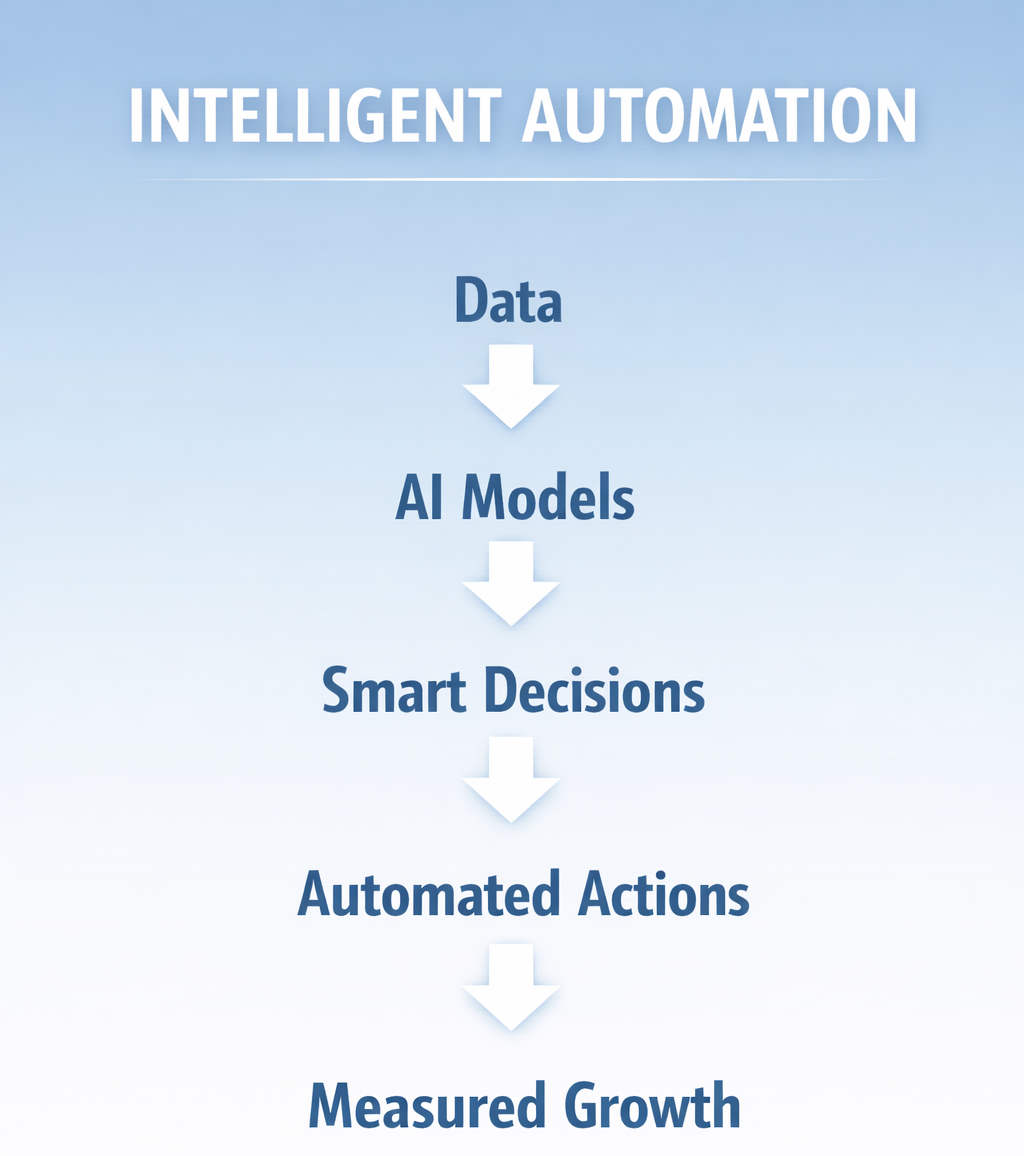
Intelligent automation is not just about replacing manual tasks. It is about making systems think, decide, and improve over time. Many organizations want this shift, but they do not know quite where to begin. That is why artificial intelligence services companies have become vital partners. They give structure to business goals. They turn scattered data and processes into quite smart flows. And they build artificial intelligence business solutions that help companies operate smoothly and accurately.
Table of Contents
Understanding Intelligent Automation
Why Traditional Automation Is No Longer Enough
The Role of Artificial Intelligence Services Companies
Designing Artificial Intelligence Business Solutions
Data: The Quiet Engine Behind Automation
From Pilot Projects to Enterprise Systems
Human Oversight in Intelligent Automation
Industry Use Cases of Intelligent Automation
Measuring Impact and Long-Term Value
The Future of AI-Driven Operations
Understanding Intelligent Automation
Automation alone is not a new idea. Businesses have used scripts and software to automate tasks for years. But intelligent automation goes even further. It brings in machine learning, natural language processing, predictive analytics, and decision systems. Instead of simply following some fixed rules, intelligent systems study data. They predict trends to come and adapt according to data analysis. This improves accuracy with time.
For example, a traditional system may route emails based on keywords. An intelligent system understands context and detects urgency. It predicts intent. Artificial intelligence services companies help organizations build such systems. They combine automation with learning, and this changes everything.
Why Traditional Automation Is No Longer Enough
Old automation tools require strict instructions. When conditions change, they fail. Modern markets change daily. Customer behavior shifts, and regulations evolve. Data volumes grow quite quickly, and a fixed system cannot keep up.
Artificial intelligence business solutions bring flexibility into operations. They allow systems to process new data patterns without rewriting entire workflows. They detect anomalies and flag risks. They recommend actions. Without this intelligence layer, automation does not perform well. With it, automation becomes adaptive, and processes become sharp.
The Role of Artificial Intelligence Services Companies
Building intelligent automation requires technical knowledge. Only people with experience with data pipelines, model training, deployment strategies, and performance optimization can use it strategically. Most companies do not have these capabilities in-house.
Artificial intelligence services companies fill this acute gap. They study business processes and identify automation opportunities. They design AI architectures and build and deploy models. More importantly, they ensure that the automation matches with business goals. They know that technology without direction and AI without governance creates risk.
These service companies bring structure. They bring tested frameworks that reduce trial and error.
Designing Artificial Intelligence Business Solutions
Artificial intelligence services companies begin with discovery. They map workflows. They identify repetitive tasks and analyze decision points.
Then they design artificial intelligence business solutions that address real friction. This may include:
- Intelligent chatbots for customer service
- Predictive analytics for sales forecasting
- AI-powered document processing
- Fraud detection systems
- Automated recruitment screening
Each solution is built using measurable outcomes. Here, time is saved, errors are reduced, and revenue is improved. The focus is on impact.
Data: The Quiet Engine Behind Automation
Intelligent automation runs on data that is very clean, structured, and quite relevant. Artificial intelligence services companies help organizations prepare this foundation. They build data pipelines and integrate systems. They clean historical records.
Without quality data, AI models produce quite weak results. With proper data engineering, artificial intelligence business solutions become very accurate and reliable. Data governance also matters. Privacy rules must be respected. Security must be enforced, and ethical boundaries must be carefully defined. These companies ensure that intelligence covers all these areas.
From Pilot Projects to Enterprise Systems
Many businesses begin AI adoption with small pilots, like a chatbot here and a reporting tool there. The challenge comes when scaling; these pilots often remain isolated experiments.
Artificial intelligence services companies design systems that can grow. They deploy AI models into cloud environments. Here, scaling is quite easy. They integrate with ERP systems, CRM platforms, and internal dashboards. They monitor performance and retrain models. They ensure uptime. This shift from pilot to enterprise-level deployment defines true intelligent automation.
Human Oversight in Intelligent Automation
Automation does not take the place of humans. It changes their role. Employees move from repetitive tasks to supervisory and strategic roles. They review AI recommendations. They intervene when needed and interpret results.
Artificial intelligence business solutions work best when humans remain involved. Oversight prevents any bias and maintains accountability. Artificial intelligence services companies often design hybrid workflows. AI handles volume, and humans handle nuance. The result is an equilibrium that fuels growth.
Industry Use Cases of Intelligent Automation
Intelligent automation is not quite limited to one sector. It affects many industries.
- In finance, AI detects fraud patterns in real time.
- In healthcare, AI assists in patient data analysis.
- In retail, AI predicts demand and optimizes inventory.
- In manufacturing, AI forecasts equipment failures.
- In recruitment, AI screens resumes and identifies suitable candidates.
Artificial intelligence services companies use artificial intelligence business solutions according to each sector’s needs. They understand compliance rules and make sure they meet with industry standards. Here, content and customization are important.
Measuring Impact and Long-Term Value
Intelligent automation must deliver measurable outcomes. Key performance indicators often include reduced operational costs and faster response times. They also include improved accuracy and enhanced customer satisfaction.
Artificial intelligence services companies establish tracking frameworks. They measure before and after performance. They calculate return on investment. They also plan for continuous improvement. Data patterns evolve, and business needs shift. AI models require monitoring. They offer long-term support, leading to sustainable value.
The Future of AI-Driven Operations
The future of work is not really about replacing people. It is more about augmenting systems. Intelligent automation will expand to include strategic decision-making. Predictive systems will guide marketing campaigns. AI assistants will support executives with real-time insights.
Artificial intelligence services companies will continue to shape this process. They will bring in technological capability to bridge business goals. Artificial intelligence business solutions will become embedded in everyday operations. It will be invisible yet quite essential.
Organizations that adopt intelligent automation early will operate effortlessly. Those who delay may struggle to compete.
FAQs
1. What do artificial intelligence services companies actually provide?
They offer consulting, AI development, system integration, deployment, and ongoing optimization. They help businesses implement intelligent automation.
2. Are artificial intelligence business solutions suitable for small businesses?
Yes. Scalable AI models can be customized to suit startups and mid-sized companies. It all depends on budget and operational needs.
3. How long does it take to implement intelligent automation?
Timelines vary. They depend on project scope, data readiness, and integration requirements.
4. Is intelligent automation secure?
When designed properly with governance and security protocols, AI systems can be highly secure and compliant with regulations.
5. Do companies need in-house AI experts after implementation?
Not always. Many businesses rely on artificial intelligence services companies for ongoing support and optimization.
Conclusion
Intelligent automation is not just a passing trend. It is a structural shift in how businesses operate. It blends logic with learning. It transforms processes into adaptive systems.
Artificial intelligence services companies act as architects of this transformation. Through carefully designed artificial intelligence business solutions, they help organizations move from manual strain to digital competence. The path is quite complex, but with the right partner, it becomes quite steady and clear.
Ready to Turn Automation into Intelligence?
Recruit Ninjas helps businesses connect with skilled AI professionals who build structured, secure, and scalable AI systems. With the right expertise, your systems can learn, adapt, and scale without confusion.
Start Building with Recruit Ninjas
Suggested Reads
https://www.recruitninjas.com/blog/are-ai-skill-assessment-tools-more-accurate/ – Explores whether AI skill assessment tools truly improve hiring accuracy.
https://www.recruitninjas.com/blog/ai-applicant-tracking-human-oversight/ – Discusses the balance between AI applicant tracking systems and human oversight.
https://www.recruitninjas.com/blog/microsoft-layoffs-signal-ai-driven-restructuring-ahead/ – Analyzes how AI-driven restructuring is reshaping workforce strategies.
https://www.recruitninjas.com/blog/how-ai-helps-recruiters-in-intelligent-candidate-sourcing/ – Highlights how AI enhances intelligent candidate sourcing in recruitment.

recruitninjas
Cynthia David is a Principal Product Marketing Manager for Adobe Document Cloud, focusing on Acrobat, Acrobat Sign, and Acrobat Services. She has background in messaging, marketing campaigns, communications, social media, events, content marketing, and partnerships. She is passionate about understanding customer needs and connecting with customers.